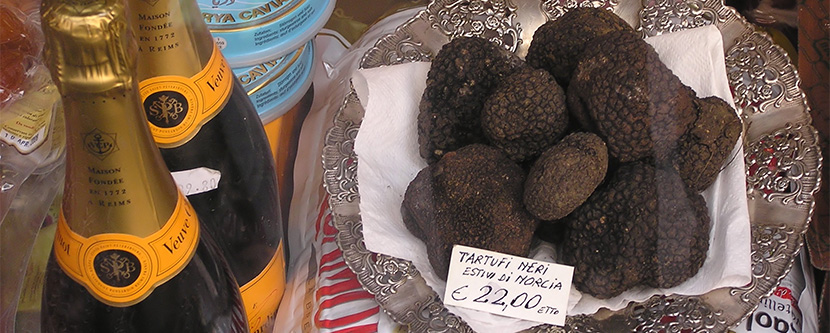
Two species sit at the top of European truffle culture: the white Alba truffle (Tuber magnatum Pico) and the black Périgord (Tuber melanosporum Vittadini). Together they account for almost the entire cultural prestige of the genus, and almost the entire restaurant carte. They are not, however, interchangeable. Their botany, their season, their price, their aroma and their cooking rule all run in opposite directions. The page below compares them point by point and concludes with a decision matrix.
The side-by-side table
| White Alba (magnatum) | Black Périgord (melanosporum) | |
|---|---|---|
| Botanical name | Tuber magnatum Pico (1788/1831) | Tuber melanosporum Vittadini (1831) |
| Common name | Alba truffle, white truffle | Périgord truffle, black truffle |
| Season | October – January | December – March |
| Peak weeks | mid-October to mid-November | mid-January to end of February |
| Origin region | Piedmont (Roero, Bassa Langa); Istria, Marche, Umbria | Périgord (Sarlat); Aragón (Teruel); Umbria; Provence |
| Cultivable? | No — wild forage only | Yes — 80 % of harvest from inoculated plantations |
| Soil & host | calcareous, pH 7.5–8.5, oak / poplar / hazel / lime | calcareous, pH 7.5–8.5, downy oak / holm oak / hazel |
| Peridium colour | smooth, ivory to pale ochre | warty, deep black with pyramidal protrusions |
| Gleba colour (cut) | cream to nut-brown, fine white veins | black to violet-black, fine white marbling |
| Aroma profile | garlic, aged cheese, honey, musk; volatile | earth, dark chocolate, roasted hazelnut, animalic; stable |
| Dominant volatile | bis(methylthio)methane | dimethyl sulphide, androstenone |
| Heat tolerance | None — never heat | Yes — gentle heat opens it up |
| Cooking rule | shave raw on a finished, warm plate | warm gently into a sauce, under skin, en croûte |
| Freezable? | No — destroys aroma | Yes — keeps three to four months |
| Storage life (fresh) | 3–5 days | 5–7 days |
| Retail price 2026 (CHF/kg) | 3,000 – 6,000 | 1,200 – 2,500 |
| Per-portion cost (5 g) | ~CHF 15 – 30 | ~CHF 6 – 12 |
| Defining institution | Centro Nazionale Studi Tartufo, Alba (1976) | Fédération Française des Trufficulteurs |
| Defining market | Fiera Internazionale del Tartufo Bianco, Alba | Marché aux truffes, Lalbenque (Quercy) & Sarlat |
| Cuisine of origin | Piedmontese (Italian) | French haute cuisine |
| Signature dish | tajarin al tartufo bianco | sauce Périgueux, poularde demi-deuil |
Two opposite seasons
The most underrated difference is the calendar. White Alba and black Périgord overlap by perhaps two weeks in late December and early January — and even in that overlap, both are slightly past peak. For most of the year, only one of the two is meaningfully available. Buyers planning around either species have to plan around the calendar first, the species second.
The Alba season is short and sharp: it opens in October, peaks in November when the Fiera in Alba is at full speed, sustains through December and tails off in January. The Périgord season opens in December, peaks in late January and February when the cold has set the ripening clock, and runs to mid-March. A working kitchen that wants to cook with truffles year-round therefore leans on the summer truffle (May–September) and the burgundy (September– January) to fill the gaps; see Season & presence.
Two opposite cooking rules
The Alba rule is one of the strictest in European cooking: never heat. The volatile compounds that define the species evaporate in minutes once cut, and any direct heat past 40 °C destroys them irreversibly. The technique is therefore raw shaving on a finished, warm plate — tagliolini al burro, fonduta, a soft fried egg, a Fassona carpaccio. Four to six grams per portion is a complete dish.
The Périgord rule is the inverse: warm gently. The aroma opens up under mild heat (around 60–80 °C), and the species holds its character through several minutes of cooking. The classical French preparations — sauce Périgueux, poularde demi-deuil, brouillade en croûte de pain — all rely on warming, never on raw shaving and never on full searing heat.
A French recipe written for Périgord cannot be transposed to Alba; an Italian recipe written for Alba cannot be transposed to Périgord. The two species occupy disjoint cooking universes.
Two opposite economies
The Alba market is volatile: short season, wild-only supply, no central exchange, prices that can move 30–50 % week to week with the weather. The Périgord market is calmer: longer season, cultivated supply that buffers weather shocks, freezable product that allows stored stock to be a legitimate part of the trade. The Périgord retail price tracks the harvest by 10–20 % over a season; Alba can move in a single week.
Both species face substitution risk. The black Périgord is most commonly replaced by the Chinese Tuber indicum, morphologically similar but aromatically much thinner. The white Alba is replaced by Tuber borchii (bianchetto), a milder relative ripening from late January. Defending against either substitution requires the same discipline: insist on the botanical name on the receipt, the harvest date and the dealer\'s registration; see Where to buy truffles and Truffle prices.
Decision matrix
Three questions determine which species is right for a given occasion.
- What is the season? If October to early December: Alba is at peak. If late January to February: Périgord. Outside both windows, neither — fall back on burgundy or summer.
- How is the dish constructed? If the dish is finished, warm and simple — Alba. If the dish involves a sauce, a stock, a stuffing or a crust — Périgord.
- What is the budget per portion? Alba runs CHF 15–30 per 5 g portion; Périgord runs CHF 6–12. For a four-person dinner, that is the difference between roughly CHF 60–120 and CHF 25–50 of truffle on the table.
A simple working rule: in November, with a plate of fresh egg pasta and good butter, choose Alba. In February, with a roasted Bresse chicken and a glass of Madeira, choose Périgord. In March, choose neither and wait for May.
The two queens never share a stage. They share a genus.
Read both full profiles
For each species, we maintain a long-form article covering botany, history, market, cuisine and sources:
- White Alba truffle (Tuber magnatum) — the queen of autumn.
- Black Périgord truffle (Tuber melanosporum) — the queen of winter.
For the two complementary species that fill the calendar, see burgundy truffle (Tuber uncinatum) and summer truffle (Tuber aestivum); for the buying side, Where to buy truffles.
Frequently asked questions
Which is more expensive, white or black truffle?
Which has more flavour, white or black truffle?
Can the black Périgord be used in place of white Alba?
Which one should a beginner try first?
Are white and black truffles related?
Can both grow in the same forest?
Which is harder to fake?
Glossary
- Tuber magnatum Pico
- The white Alba truffle. Wild-only, October–January, never heated. Type species of the high-end Italian autumn truffle market.
- Tuber melanosporum
- The black Périgord truffle. Cultivable since 1808, December–March, gentle heat tolerated. Type species of the French winter haute cuisine.
- Mycorrhiza
- The symbiosis between truffle and host tree. Stable for melanosporum (which therefore farms reliably), unstable for magnatum (which therefore does not).
- Bis(methylthio)methane
- The dominant volatile of magnatum; the molecule that makes the Alba aroma read so unmistakably.
- Androstenone
- The boar pheromone-related volatile shared between melanosporum and pig saliva. The historical reason pigs hunt truffles so reliably; in cuisine, the source of the Périgord\'s animalic depth.
- Substitution risk
- The systematic replacement of a high-value species by a lower-value lookalike. Indicum for melanosporum; borchii for magnatum. Defended against by botanical-name receipts and dealer registration.
Sources
- Vittadini, C. (1831). Monographia Tuberacearum. Milan. Founding scientific monograph; both species formally described.
- Pico, V. (1788). Meletemata inauguralia. University of Turin. First technical description of magnatum.
- Hall, I. R., Brown, G. T. and Zambonelli, A. (2007). Taming the Truffle. Timber Press, Portland — comparative chapter on the two species.
- Splivallo, R. et al. (2011). "Truffle volatiles: from chemical ecology to aroma biosynthesis." New Phytologist, 189(3): 688–699 — comparative aroma chemistry.
- Büntgen, U. et al. (2019). "Black truffle winter production depends on Mediterranean summer precipitation." Environmental Research Letters, 14: 074004 — the climate–yield link, asymmetric between the two species.
- Centro Nazionale Studi Tartufo, Alba — the magnatum grading authority (tuber.it).
- Fédération Française des Trufficulteurs — the melanosporum producer federation.
- Escoffier, A. (1903). Le Guide Culinaire. Codifies the French cooking tradition built around melanosporum.