The white truffle (Tuber magnatum Pico) — also called the Alba truffle — is regarded as the royal family of truffles. It is exceptionally rare, harvested only between October and January, and reaches the market exclusively from wild forage. The principal source is Piedmont in northern Italy, in particular the area around the town of Alba, where the finest specimens come up year after year on the same calcareous soils.
A name from 1788
The species owes its scientific name to two figures separated by half a century. In 1788 Vittorio Pico, a physician at the University of Turin, included the white Piedmontese truffle in his medical inaugural thesis Meletemata inauguralia — the first technical description of the species in print. In 1831 the Milanese mycologist Carlo Vittadini, in his Monographia Tuberacearum — the founding scientific work on European truffles — formally raised the species to its modern name and added the dedication: Tuber magnatum Pico, "Pico's truffle of the magnates", a Latin nod to the courtly circles in which the truffle had long been served.
The truffle had reached those circles much earlier. The royal House of Savoy in Turin used the white truffle as a diplomatic gift from at least the seventeenth century — sealed in linen, packed in moss, dispatched to the courts of Paris, Vienna and London, where it arrived perfumed, half-spoiled and entirely myth-laden. The villages of the Roero and the Langhe, on the chalky hills west and east of the river Tanaro, learnt to find and grade truffles in this period; the trifulau (truffle hunter) and his tabui (the dog) entered local folklore around the same time.
The town of Alba — Roman Alba Pompeia — became the formal capital of the trade in 1929, when the hotelier Giacomo Morra began organising weekly truffle markets through the autumn. By the 1950s Morra had institutionalised the practice into the Fiera del Tartufo, today the Fiera Internazionale del Tartufo Bianco d'Alba, and shipped truffles to figures including Marilyn Monroe and Winston Churchill — a marketing gesture that would today be called product placement. The town has been synonymous with the white truffle ever since.
Appearance, cut and aroma
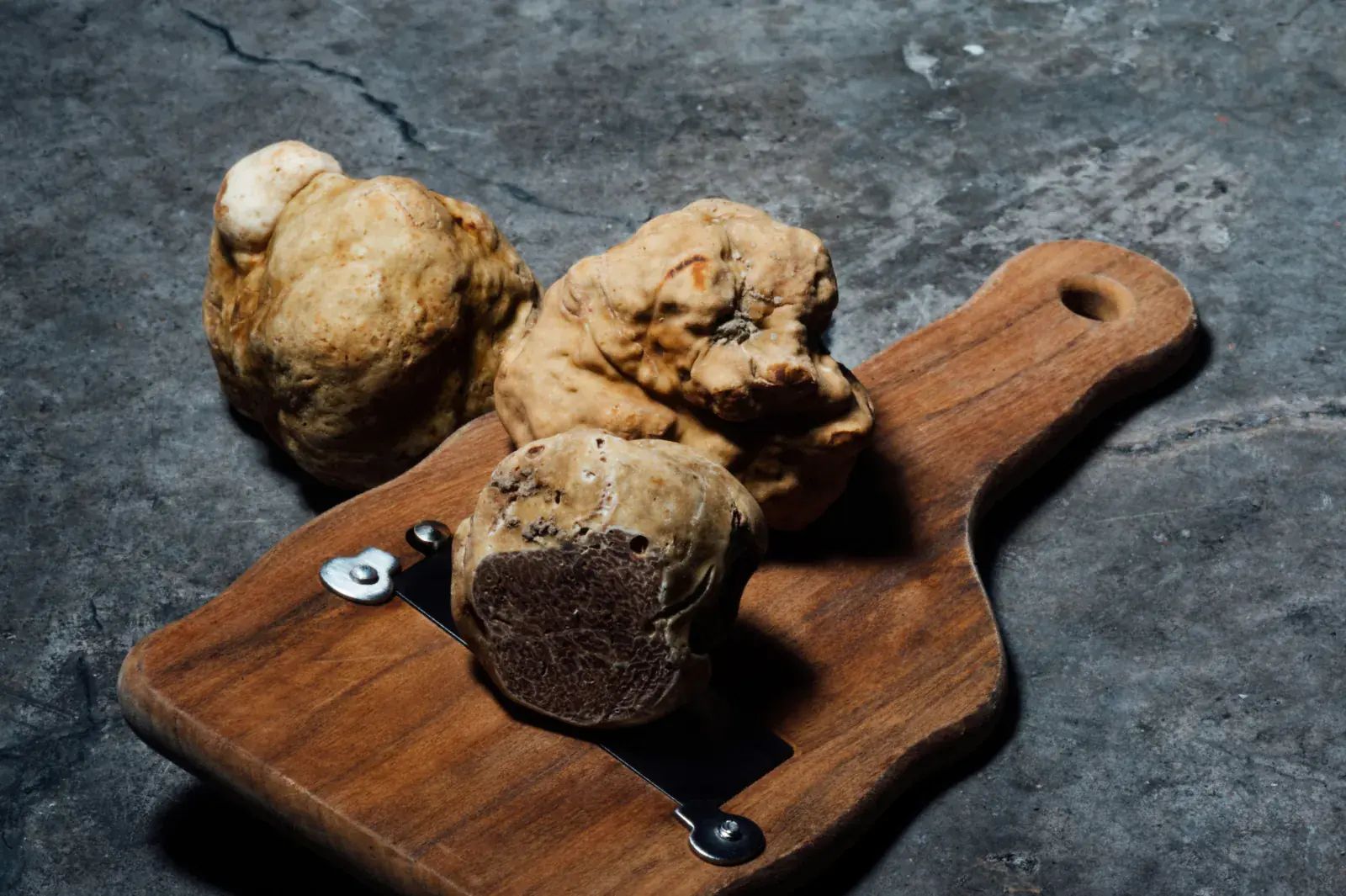
The Alba truffle has a smooth, characteristically pale outer skin (the peridium), ranging from white through cream to pale ochre, occasionally with pink-marbled veins where the fruiting body has rubbed against root or stone. The flesh (the gleba) is light cream to hazel, tightly veined with thin white lines that form a fine, regular marbling visible only when the truffle is sliced thin. A ripe specimen feels firm and slightly springy under the thumb; a soft truffle is over-ripe, a hard one immature.
The aroma sets the white Alba apart from every other species in the genus. It combines garlic, ripe alpine cheese, honey, moss and a high musky note that experienced cooks and dealers learn to recognise across a closed room. Chemical analyses (Splivallo et al., 2011) identify bis(methylthio)methane as the dominant compound, alongside several thioethers and free amino acids — but no laboratory mixture reproduces the living scent. Unopened, an Alba truffle perfumes a room within minutes; once cut, the volatile compounds dissipate within hours.
Why it cannot be cultivated
Every serious attempt to bring Tuber magnatum into cultivation has failed. Inoculated seedlings of oak, poplar, hazel and lime can be raised in nurseries and planted in calcareous soil that mimics the Roero hills, but the symbiosis between fungus and tree (the mycorrhiza) is unstable: the fungus colonises the seedling's roots in the nursery and disappears within a few years in the field. Climate, neighbouring microorganisms and the chemistry of the rhizosphere all appear to matter, and the precise combination eludes researchers (Hall, Brown and Zambonelli, Taming the Truffle, 2007; Murat et al., 2018).
Two cultivated harvests have been reported as exceptions — a single fruiting body in France in 1999 and a small French plantation reported in 2018 — but neither has scaled. Every kilo on the autumn market reaches it from wild ground, mostly in Piedmont and a smaller, growing share from Istria.
Where it grows
The bulk of the world's harvest comes from a corridor running from the Maremma in southern Tuscany, north through Umbria, Emilia-Romagna and Piedmont, to the alpine foothills of Lombardy and the Veneto. Within Piedmont, the Roero — a hilly belt north-west of Alba — and the Bassa Langa to the south yield the most refined specimens: pale, firm, intensely scented, with the long shelf life that informed buyers prize. Smaller productions come from the Marche (Acqualagna), Molise (San Pietro Avellana) and Tuscany (Volterra and San Miniato). Each region runs its own autumn fair and grading culture; Alba has the largest international audience, but Acqualagna and San Miniato are increasingly visible.
Beyond Italy, the Istrian peninsula in Croatia produces a respectable share of the harvest — a coastal-Mediterranean climate band around the river Mirna, beneath oak and hornbeam forests. Slovenia, southern France (Drôme, Vaucluse) and parts of Hungary report sporadic productions. Switzerland is climatically marginal: a handful of authenticated finds from the Geneva basin and the Jura have been recorded, but the Confederation is a market for the Italian harvest, not a producer.
- Botanical
- Tuber magnatum
- Season
- October – January
- Region
- Piedmont · Istria
- Market price
- CHF 3,000 – 6,000/kg
Season at a glance
Although the law allows harvesting from late September in some Italian regions, the truffles reaching the market in early October are mostly immature. The full quality window opens around mid-October and runs through to the close of the year; a small tail of harvest continues into January, but quality has typically declined by then. By February the market has effectively closed.
- Early October: first harvest, mostly small and immature, prices already high because of scarcity.
- Mid-October to mid-November: peak quality. The Alba fair is in full swing; the world auction is held.
- Late November to mid-December: a second peak as autumn rains feed late ripening; specimens are often larger.
- Mid-December to mid-January: tail of the season. Quality varies; informed buyers verify the harvest date.
- February onward: stored stock only — refuse it.
The market
White-truffle prices fluctuate more strongly than any other culinary fungus. Three factors explain the volatility:
Yield depends on rainfall through summer and early autumn. Dry years compress the harvest into a few weeks and drive prices to seasonal highs; wet years extend the season and soften them. Climate-driven shifts have been observed across the past two decades, and yields have trended downward overall (Büntgen et al., 2019).
Quality is graded at the source. The Centro Nazionale Studi Tartufo in Alba (founded 1976) certifies the lots that pass through the official autumn market on physical and aromatic criteria — firmness, peridium intactness, gleba marbling, aroma — and assigns letter grades from A (top) to C (commercial). Lower grades trade at a fraction of the headline price.
The Asta Mondiale del Tartufo Bianco — the World Truffle Auction — is held each November at the Castello di Grinzane Cavour, on a hill above the river Tanaro. A single ceremonial lot of 800 g to 1 kg has fetched between EUR 100,000 and EUR 350,000 in recent years, with the proceeds passing to charity. The auction attracts collectors from Hong Kong, the Gulf and Manhattan and sets a psychological ceiling that radiates outward across the season.
Headline retail ranges, October to December: CHF 3,000–6,000 per kilo for graded A specimens, CHF 1,500–2,500 for B, lower for C. Smaller sizes (10–20 g) trade per gram at a premium. Where to buy with confidence: registered Italian and Swiss dealers, the Alba autumn market itself (open daily October to early December, weekends through Christmas), and a small number of Swiss and German specialist importers who source through registered Italian channels. See Where to buy truffles and Truffle prices for the longer guide.
In the kitchen
The white Alba truffle must never be heated. Its volatile aromatic profile is measured in seconds, not minutes: two minutes on a hot pan and the high notes have escaped, leaving a fungal residue that no amount of salt can rescue. The professional rule is simpler still: bring the truffle to the plate, not the plate to the truffle.
Shave razor-thin (the traditional cuneo or steel mandoline does this; a crude grater bruises the flesh and scatters aroma) over a finished, lukewarm dish. The dish should be plain enough to receive the truffle without competing: butter, eggs, fresh egg pasta, a soft polenta, a poached chicken breast, raw beef. Four to six grams per portion are sufficient — anyone going to ten is announcing wealth, not flavour.
Pairings to avoid: vinegar, citrus, strong herbs, garlic, mature cheese (too close to the truffle's own profile). Pairings that work: butter, mild dairy fats, a single yolk, mild Parmigiano-Reggiano grated lightly, an excellent extra-virgin olive oil used sparingly. At table, a Nebbiolo from the Langa or a Barbera d'Alba.
Storage between purchase and use: wrapped in fresh paper towel, in an airtight glass jar, in the warmest part of the refrigerator. Change the towel every day. Three to five days from purchase is the working window; thereafter the aroma flattens noticeably. Eggs stored in the same jar take on the aroma overnight — an old kitchen trick. See Storing truffles for the full method.
Four classic dishes
Brief sketches, in roughly ascending complexity. None of these recipes ask for technique you do not already have; the work is in the timing.
Tajarin al tartufo bianco
Fresh egg pasta — five or six yolks per 100 g of double-zero flour, kneaded smooth, rested half an hour, rolled to almost translucent — cut into 2 mm ribbons. Boil in salted water for sixty seconds, drain, toss with a generous knob of unsalted butter and a spoon of pasta water, no more. Plate. Shave 4–6 g of truffle directly over each portion at the table. The dish of the Roero, almost compulsory in Alba.
Fonduta alla piemontese con tartufo
The Piedmontese mountain fondue — Fontina cheese diced fine, soaked in milk for an hour, melted very gently with butter and an egg yolk over a bain-marie until it pulls into a smooth, pale cream. Spoon into warm bowls; shave truffle over the surface. A toast of country bread alongside, no more. The fonduta carries the truffle on its dairy weight without ever competing.
Uovo all'occhio di bue, tartufo e burro nocciola
A single fresh yolk, fried in clarified butter at low heat until the white sets and the yolk remains liquid. Slide onto a warm plate. Spoon over a teaspoon of butter heated to noisette (pale brown, hazelnut-scented). Shave 3–4 g of truffle. A toast of country bread on the side. Breakfast, lunch or supper, in that order.
Carpaccio di Fassona con tartufo
Raw Fassona beef from the Piemontese breed, sliced wafer-thin, dressed with the lightest olive oil and a flake of fleur de sel. No lemon, no rocket, no parmesan: only the meat and the truffle, shaved generously over the top. The dish that perhaps best demonstrates the Italian rule — that simplicity is a method, not a default.
Frequently asked questions
Why is the white Alba truffle never heated?
What is a fair price for a fresh Alba truffle in Switzerland?
How do I tell a real Alba truffle from a Chinese imitation?
Can the white Alba truffle be farmed?
How long does an Alba truffle keep?
Where exactly does it grow?
What is the World Truffle Auction?
Glossary
- Trifulau
- Piedmontese dialect for the truffle hunter. The trade is heritable; many Roero families count three or four generations of trifulau.
- Tabui
- The truffle dog. In Piedmont, often a Lagotto Romagnolo or a mongrel selected for nose, temperament and patience. See Truffle dog and truffle pig.
- Cuneo
- The flat steel mandoline-shaver used to slice truffle razor-thin at the table. Adjustable; an experienced waiter sets it to the truffle, not the other way round.
- Mycorrhiza
- The symbiosis between truffle and host tree. The fungus exchanges minerals and water for sugars; the fruiting body is the rare visible expression of an otherwise hidden underground network.
- Peridium · Gleba
- The outer skin and the flesh, respectively. Both are diagnostic: smooth pale peridium and fine cream marbling identify magnatum.
- Asta Mondiale
- The World Truffle Auction, held each November at the Castello di Grinzane Cavour. Charity-driven; ceremonial single lots have fetched up to EUR 350,000.
Sources
- Vittadini, C. (1831). Monographia Tuberacearum. Milan. The founding scientific monograph on European truffles.
- Pico, V. (1788). Meletemata inauguralia. University of Turin. First technical description of the white Piedmont truffle.
- Hall, I. R., Brown, G. T. and Zambonelli, A. (2007). Taming the Truffle: The History, Lore and Science of the Ultimate Mushroom. Timber Press, Portland.
- Splivallo, R. et al. (2011). "Truffle volatiles: from chemical ecology to aroma biosynthesis." New Phytologist, 189(3): 688–699.
- Murat, C. et al. (2018). "Pezizomycetes genomes reveal the molecular basis of ectomycorrhizal truffle lifestyle." Nature Ecology & Evolution, 2: 1956–1965.
- Büntgen, U. et al. (2019). "Black truffle winter production depends on Mediterranean summer precipitation." Environmental Research Letters, 14: 074004. — useful comparator for climate-yield analysis.
- Centro Nazionale Studi Tartufo, Alba — quality grading, harvest data, autumn-market certification (tuber.it).
- Ente Fiera Internazionale del Tartufo Bianco d'Alba — official autumn fair body, founded by G. Morra in 1929 and reorganised in the 1950s.