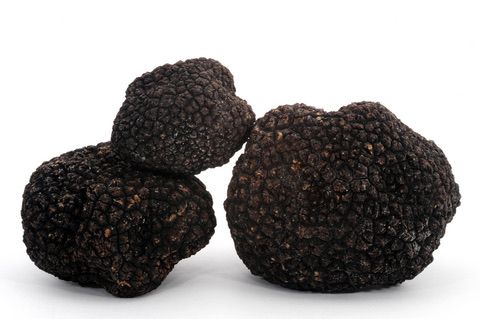
The Burgundy truffle (Tuber uncinatum) belongs botanically to the same family as the summer truffle but ripens later and carries a noticeably stronger aromatic profile. It comes up between September and January in Burgundy, Switzerland, Bavaria, northern Italy and the woodlands of Central Europe — often beneath the same trees under which aestivum grew earlier in the summer. Among professionals, the Burgundy enjoys an underground reputation that the more famous species do not: a serious, affordable culinary truffle that opens the door to the genus without the price or fragility of its cousins.
The uncinatum question
Modern molecular taxonomy has clouded a once-clear picture. For most of the twentieth century Tuber uncinatum (the Burgundy) and Tuber aestivum (the summer truffle) were treated as separate species — distinguished by season, gleba colour, and aroma. Genetic analyses through the 2000s suggested the two forms share an effectively identical genome (Paolocci et al., 2004; Mello et al., 2006), and many taxonomic authorities now treat them as seasonal forms of a single species under the name Tuber aestivum Vittadini. Practical use, however, has retained the older naming: dealers and chefs continue to call the autumn form Burgundy and the summer form scorzone, because the differences a kitchen notices — colour, smell, season — are real even if the genome is shared.
The species was first described by Jacques-Cosme Chatin in 1869 (Le Truffe, Paris) and named uncinatum for the small hooked warts (Latin uncinatus, "hooked") visible under the microscope on the spore surface. Whether one prefers the older split or the newer lump, the autumn truffle of central France and Switzerland keeps its working name.
Aroma and character
The Burgundy's aroma calls to mind hazelnut, cocoa, damp woodland soil and a warm bread-crust note that distinguishes it cleanly from the summer truffle. It is stronger than aestivum but less volatile than the white Alba. It tolerates a brief warming, holds its character through several minutes of cooking, and is therefore suited to a wide range of dishes — from risotto to beef tartare to stuffed saltimbocca.
The cut is diagnostic: gleba dark chocolate brown to black-brown, with fine white veins spreading through the section in a regular pattern. The peridium is dark brown to black, studded with shallow polygonal warts — flatter and softer than the pyramidal warts of melanosporum. A ripe Burgundy is firm but slightly yielding to thumb pressure; a hard one is immature, a soft one over-ripe.
Where it grows
The species' name fairly reflects its core territory. Burgundy itself — the limestone hills around Châtillon-sur-Seine, Auxerre and Dijon — produces the original named harvest. From there the range extends north into Champagne, east into Lorraine and across the Jura into western Switzerland. The Swiss Mittelland from Geneva to St. Gallen yields a substantial harvest in good years; isolated truffle traditions persist in Vaud and the Bernese Jura. Bavaria, Baden-Württemberg and parts of Austria contribute further; in northern Italy, the truffle is found in Piedmont, Lombardy and the Veneto, often alongside summer specimens.
The species is more catholic in its taste than the white Alba: oak, hazel, hornbeam, beech, lime — almost any deciduous host on calcareous soil will do. This wide host range is why the Burgundy is the only truffle of culinary weight regularly hunted across Switzerland and Germany, and why amateur trufficulture in Central Europe is built mostly around uncinatum.
- Botanical
- Tuber uncinatum
- Season
- September – January
- Region
- Burgundy · Switzerland · Bavaria
- Market price
- CHF 400 – 900/kg
A Swiss speciality
In Switzerland the Burgundy is the most common culinary truffle of all. It grows from the western cantons across the midlands to Ticino in mixed woodlands on calcareous soil. Unlike Germany, where every native truffle species is strictly protected and hunting is generally forbidden, hunting in Switzerland is permitted under defined conditions: a cantonal permit (Trüffelschein), daily quantity limits, restricted tools, and the landowner's consent on private ground. The Swiss truffle association (Schweizerische Trüffelvereinigung) organises training and dog instruction. See Finding truffles in Switzerland for the canton-by-canton picture; for the German rules see Finding truffles in Germany.
The market
The Burgundy market is calmer than that of the white Alba and quieter than that of the Périgord. Three structural reasons: the species is widely distributed, the harvest is longer (four to five months), and the species freezes well, which softens the seasonality of the trade. Prices are correspondingly steadier: roughly CHF 400 to 900 per kilo through the autumn, with peaks during scarce weeks. Smaller pieces from the same harvest run around CHF 50 to 100 per 100 g.
Where to buy with confidence: registered Swiss dealers and weekly producer markets in the western cantons (Vaud, Geneva), specialist greengrocers in Zurich and Bern, French dealers around Châtillon-sur-Seine, and Italian dealers from the Piedmontese borderlands. See Where to buy truffles and Truffle prices for the longer guide. A small producer truffle market runs in Bonvillars, canton Vaud, on a weekend in October each year — the Swiss equivalent of an Italian autumn fair.
In the kitchen
The Burgundy occupies a useful middle ground. Stronger than the summer truffle, more forgiving than the white Alba, robust enough to bear gentle heat without losing its character, and priced for everyday use rather than ceremony. Shave thin over finished dishes — risotto, pasta, eggs, a butter-poached fillet, beef tartare — or stir into a butter sauce off the heat. A whole truffle wrapped in butter or cream and gently warmed releases its aroma cleanly.
Pairings that work: butter, eggs, mild dairy, root vegetables (potato, celeriac, parsnip), chestnut, hazelnut, mushrooms, mild game. Pairings to avoid: vinegar, citrus, raw onion, overpowering herbs. At table, a Burgundy white (Chablis, Meursault), a Swiss Chasselas, or a young Pinot Noir from the Jura. Ten grams in a dish for four people gives a confident truffle reading without ostentation.
Three everyday dishes
Brief sketches, scaled to home cooking. None of these recipes ask for technique you do not already have.
Tagliatelle au beurre, truffe de Bourgogne
Fresh egg tagliatelle, boiled in salted water, drained, tossed with unsalted butter and a spoon of pasta water. Plate. Shave 5–8 g of Burgundy directly over each portion. A finer sprinkle of Parmigiano if wanted, but the dish is complete without. Italian by inheritance, Swiss by adoption.
Œuf cocotte à la truffe de Bourgogne
A single fresh egg cracked into a buttered ramekin, a spoon of cream, salt, a generous grating of truffle. Bake in a low water bath at 140 °C for ten to twelve minutes — the white just set, the yolk still liquid. Toast on the side. The dish that perhaps best demonstrates the species' tolerance for heat.
Risotto au céleri-rave et truffe de Bourgogne
Risotto with diced celeriac sweated in butter, stock added by the ladle, finished with butter and Parmesan in the Italian manner. Off the heat, stir in 5 g of Burgundy per portion finely chopped, plus a final shave on top. The earthiness of the celeriac and the cocoa note of the truffle are made for each other. A Swiss-Burgundian autumn dish, common from Lausanne to Lyon.
Frequently asked questions
How does the Burgundy truffle differ from the summer truffle?
Can I hunt for truffles in Switzerland?
How do I choose a good Burgundy truffle?
How long does a Burgundy truffle keep?
What does it cost?
Is the Burgundy a beginner truffle?
Glossary
- Trüffelschein
- The Swiss cantonal truffle permit. Valid for a single hunting season; conditions vary by canton. The German equivalent does not exist — hunting is generally forbidden across the Federal Republic.
- Scorzone
- Italian for "rough rind". The summer form of the species, marketed alongside the autumn Burgundy at the same Italian fairs.
- Mittelland
- The Swiss midlands — the broad calcareous plateau between Geneva and St. Gallen. Productive ground for the Burgundy across most of its length.
- Mycorrhiza
- The symbiosis between fungus and host root. Tuber uncinatum is unusually catholic in choice of host; the Burgundy hunter learns to read trees rather than soil.
- Bonvillars
- The Swiss village in canton Vaud that hosts a small autumn truffle market; the closest local equivalent to an Alba or Norcia fair.
Sources
- Vittadini, C. (1831). Monographia Tuberacearum. Milan. The Burgundy was originally treated under Tuber aestivum in this work; uncinatum was described as a separate species by Chatin in 1869.
- Chatin, A. (1869). La Truffe : étude des conditions générales de la production truffière. Paris. The Burgundy is described and named here.
- Paolocci, F. et al. (2004). "Re-evaluation of the Tuber aestivum species complex by molecular markers." FEMS Microbiology Letters, 247(1): 41–47.
- Mello, A., Murat, C. and Bonfante, P. (2006). "Truffles: much more than a prized and local fungal delicacy." FEMS Microbiology Letters, 260(1): 1–8.
- Hall, I. R., Brown, G. T. and Zambonelli, A. (2007). Taming the Truffle. Timber Press, Portland. — chapters on uncinatum cultivation in the United Kingdom and Central Europe.
- Schweizerische Trüffelvereinigung — Swiss truffle association; cantonal training, dog instruction, and the Bonvillars market.
- Bundesamt für Umwelt (BAFU) — Swiss federal office, regulator of truffle hunting and species protection.