The black truffle (Tuber melanosporum) — also known as the Périgord truffle, after the French region of the same name — is found chiefly in the woodlands along the borders between France, Italy and Spain. Its unique, almost intoxicating aroma is widely held to be a culinary pinnacle of the winter months, and around it has built up the most elaborate culinary apparatus of any species in the genus: a French restaurant grammar of sauces, en croûte presentations and stuffed birds that has shaped European fine cooking for two centuries.
A name from Vittadini
The species was formally described by the Milanese mycologist Carlo Vittadini in 1831 in his Monographia Tuberacearum, alongside Tuber magnatum and the rest of the European genus. The epithet melanosporum means simply "with black spores" — Vittadini saw the species through the microscope and named it for what he could see, a habit that distinguishes nineteenth-century mycology at its best.
The truffle had been eaten and traded long before. Roman writers — Pliny, Apicius — describe truffles in Latin without distinguishing species; what they called tuber was probably a mixture of melanosporum, aestivum and the now-rarer Terfezia. Through the medieval centuries the truffle vanishes from the written record. It returns at the French royal court of the seventeenth century, especially under Louis XIV, where it acquires the courtly mystique that survives in the modern menu language. By the eighteenth century the Périgord — the limestone region in south-western France around Sarlat and Brive — was the recognised heart of the trade.
The nineteenth century brought a remarkable phenomenon: a French truffle boom of historic scale. Joseph Talon's 1808 plantation in the Vaucluse — oak seedlings raised from acorns gathered beneath productive truffle trees — was the first deliberate cultivation, and the knowledge spread quickly. By 1900 France was producing perhaps a thousand tonnes of black truffle a year. Two world wars, the depopulation of rural France and the loss of the small forestry economy reduced the harvest to a fraction; current annual production runs at perhaps thirty to fifty tonnes across all source countries.
Appearance and cut
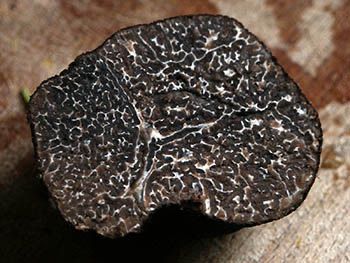
The outer skin (the peridium) is deep black with regular pyramidal warts arranged in a polygonal pattern — a useful field mark distinguishing melanosporum from the superficially similar Chinese Tuber indicum. The flesh (the gleba) is black to violet-black in cross-section, with fine white veins forming a marble-like grain that spreads regularly through the section. The texture is firm and clean — a ripe Périgord shaves into thin slices without difficulty and holds its shape on the plate.
Aromatic profile: earth, dark chocolate, roasted walnut, an animal note. Chemical analyses identify dimethyl sulphide and androstenone (the same compound also found in pig saliva — the historical reason truffle pigs respond so reliably) as among the dominant volatiles. Unlike the white Alba, the Périgord aroma is heat-stable: it opens up under gentle warming and holds its character over several minutes of cooking, which is why the entire French winter kitchen is built around it.
Where it grows
Three principal source countries: France (the Périgord, the Quercy, the Vaucluse, the Drôme), Italy (Umbria, especially around Norcia and Spoleto; the Marche; Abruzzo), and Spain (Aragon, Teruel province; Catalonia; Castile and León). Smaller productions come from Slovenia, Croatia and the more recent plantation countries — Australia, the United States, New Zealand, Chile — where mycorrhizised oaks have been planted since the 1990s.
Soil and climate are demanding: limestone (calcareous) soil, pH around 8, mediterranean climate with hot dry summers and mild wet winters, mature oak or hazel as host. The species is more cultivable than magnatum but still slow: a young plantation produces nothing in years one to seven, modestly from year eight to fifteen, and reaches its yield ceiling only in the second decade.
- Botanical
- Tuber melanosporum
- Season
- December – March
- Region
- Périgord · Umbria · Spain
- Market price
- CHF 1,200 – 2,500/kg
Cultivation and plantation
Modern Périgord plantations rely on inoculated seedlings — chiefly downy oak (Quercus pubescens), holm oak (Q. ilex) and hazel (Corylus avellana) — raised in controlled conditions until the mycorrhiza is established, then planted in cleared calcareous land. Spacing varies; six to seven metres between trees is common. The first signs of a productive site are brûlés: small bare patches around mature trees where the fungus has suppressed competing vegetation.
Around 80 % of the modern French black-truffle harvest comes from such plantations. Spanish Aragon has overtaken France in absolute volume in some recent years, with Teruel province alone supplying a significant share of the European market. Italian production remains smaller and more dispersed, with strong regional grading traditions in Umbria and Abruzzo.
Season at a glance
Tuber melanosporum's season is sharply defined by climate. Winter cold sets the truffle's biological clock; without a cold snap, ripening is delayed.
- Late November to mid-December: first specimens, frequently immature; experienced buyers wait.
- Mid-January to late February: peak quality. The fairs of Sarlat, Lalbenque (Quercy), Carpentras (Provence) and Norcia (Umbria) run their winter markets.
- March: tail of the season. Quality variable; some excellent specimens emerge after a wet winter.
- April onward: closed.
The market
The Périgord market is calmer and more institutional than the white Alba market. Prices fluctuate with weather and harvest size, but rarely with the daily volatility of the white truffle. Three reasons: the season is longer (three to four months vs. two), the supply base is larger (cultivated, not only wild) and the species freezes well (so stored stock is a legitimate part of the trade).
Headline retail, January to March: CHF 1,200 to 2,500 per kilogram for graded specimens, with a typical wholesale-retail markup of around 50 %. Spanish Aragonese specimens trade slightly below French and Italian, despite often equivalent quality, partly through historical reputation and partly through the gravity of the Périgord brand. Where to buy with confidence: French specialist dealers (Pébeyre in Cahors, the Lalbenque Tuesday market through January and February), Italian dealers around Norcia, and a small number of Swiss and German specialists who source directly from these channels. See Where to buy truffles and Périgord truffles for the longer guide.
In the kitchen
Where the white Alba's rule is "never heat", the Périgord's rule is "warm gently". The aromatic compounds open with mild heat and hold their character through several minutes of cooking; full sear-level heat, by contrast, drives off the volatile top notes. The classic French preparations — sauce Périgueux, en croûte, in a Bresse poularde, melted under brie de Meaux — all rely on warming, not searing.
Pairings that work: butter, cream, Madeira, port, foie gras, eggs, mature cheese (the Périgord is robust enough to hold its own next to a 24-month Comté), game birds, beef. The species is generous: ten grams in a sauce for four people produces a defined truffle dish rather than a mere accent. Pairings to avoid: vinegar, citrus, anything that reads acid.
Storage: wrapped in fresh paper towel, in a closed container, in the refrigerator. A whole fresh Périgord holds a week. Beyond that, freeze whole — clean with a soft brush, wrap, into an airtight container. Frozen melanosporum is a kitchen reality; frozen magnatum is not.
Four classical dishes
The Périgord has more codified preparations than any other species. The four below cover the register, from simple to ceremonial.
Œufs brouillés aux truffes
Scrambled eggs with truffle. Beat eggs in a bowl, add 4–6 g of finely chopped truffle, cover, leave overnight in the refrigerator: the aroma migrates into the yolk fat. Next day, scramble very gently in butter over a bain-marie until just set; finish with another shave of truffle. The most efficient way to taste a black truffle.
Sauce Périgueux
A reduction of Madeira and demi-glace, finished with finely chopped Périgord and butter mounted off the heat. Served over a poached chicken breast or a slice of foie gras, it is the archetype of French haute cuisine. Codified by Escoffier in Le Guide Culinaire (1903); the formula has barely shifted since.
Brouillade truffée en croûte de pain
Hollow out a country loaf, fill with the egg-and-truffle scramble, replace the lid, bake briefly at moderate heat until the crust crisps. The crust acts as both serving vessel and aromatic seal. A village dish from the Quercy, common in the winter auberges around Sarlat.
Poularde de Bresse demi-deuil
A whole Bresse chicken, slices of black truffle slid under the skin before poaching in aromatic broth. The truffle blackens the white flesh in patches — the "half-mourning" of the name. A Lyonnaise dish, codified by the chef Eugénie Brazier in the 1920s; a French Sunday centrepiece that survives, in earnest restaurants, into the present.
Risks of confusion
The Chinese Tuber indicum regularly appears on the European market, visually similar to the Périgord but aromatically far behind, traded at considerably lower prices. The species has occasionally been mis-sold as melanosporum, especially in pre-prepared products (oils, pastes, butters). Buyers ask for the botanical name and proof of origin — this is a matter of trust, not nostalgia. See also Périgord truffles and Where to buy truffles.
Frequently asked questions
What does the black Périgord truffle taste like?
Why is the Périgord truffle cultivated when the white Alba is not?
How can I tell a real Périgord from the Chinese substitute?
When is the season?
What is a fair price for a fresh Périgord truffle in Switzerland?
Can I freeze a black Périgord truffle?
What is sauce Périgueux?
Glossary
- Brûlé
- The bare patch around a productive truffle tree, where the fungus has suppressed competing vegetation. A diagnostic field sign on a working plantation.
- Cavage
- The act of locating a ripe truffle in the soil, typically with a trained dog. The dog's reward is bread or cheese; never the truffle itself.
- Trufficulture
- The cultivation of truffles. A French neologism from the late nineteenth century, now adopted in Italian (tartuficoltura) and Spanish (truficultura).
- Demi-glace
- A French stock reduction: brown veal stock and Madeira, simmered until syrupy. The base of sauce Périgueux.
- Mycorrhiza
- The symbiosis between fungus and host root. Tuber melanosporum forms ectomycorrhizae with oak and hazel; this symbiosis is what makes plantation possible.
- Marché aux truffes
- The truffle market — in France a weekly winter event in Lalbenque, Sarlat, Carpentras and a dozen smaller towns; in Italy in Norcia, Acqualagna and Alba.
Sources
- Vittadini, C. (1831). Monographia Tuberacearum. Milan. The founding scientific monograph on European truffles.
- Escoffier, A. (1903). Le Guide Culinaire. The codifying text of modern French haute cuisine; sauce Périgueux and many associated preparations are formalised here.
- Hall, I. R., Brown, G. T. and Zambonelli, A. (2007). Taming the Truffle: The History, Lore and Science of the Ultimate Mushroom. Timber Press, Portland.
- Murat, C. et al. (2018). "Pezizomycetes genomes reveal the molecular basis of ectomycorrhizal truffle lifestyle." Nature Ecology & Evolution, 2: 1956–1965.
- Büntgen, U. et al. (2019). "Black truffle winter production depends on Mediterranean summer precipitation." Environmental Research Letters, 14: 074004.
- Reyna, S. and Garcia-Barreda, S. (2014). "Black truffle cultivation: a global reality." Forest Systems, 23(2): 317–328. — overview of plantation methodology and global spread.
- Fédération Française des Trufficulteurs — federation of French truffle growers; harvest data, regional plantation registers.
- Centro Nazionale Studi Tartufo, Alba — quality grading and harvest data also for melanosporum where it is marketed alongside magnatum.