
The Périgord truffle is also known by its French name Truffe du Périgord; its botanical name is Tuber melanosporum. As with the Alba truffle, the name alone does not necessarily indicate the country of origin — the typical source countries are France, Italy and Spain, and the bulk of the modern harvest comes from cultivated plantations rather than wild forage. "Périgord" today is primarily a quality mark, less a geographical guarantee. The article below covers the region itself, the historical collapse and renaissance, the current market and the classical kitchen built around the species.
The Périgord as a region
The Périgord is a historical province in south-western France, roughly equivalent to the modern département of Dordogne with adjacent parts of Lot, Charente and Corrèze. The principal towns are Périgueux (the historical capital), Sarlat-la-Canéda (the medieval centre of the truffle trade), Bergerac and Brive-la-Gaillarde (just over the border in Corrèze). The landscape is limestone plateau cut by the rivers Vézère, Dordogne and Lot — the same valleys that gave shelter to the Lascaux cave painters, the Cro-Magnon, and a long line of mediaeval and Renaissance castles.
The truffle-bearing landscape sits chiefly in the Périgord Noir (the "black Périgord", around Sarlat) and the Périgord Blanc (around Périgueux), on limestone soils between 100 and 400 m altitude. Mature stands of Quercus pubescens (downy oak) and Q. ilex (holm oak) provide the standard host. The climate is sub-Mediterranean: warm dry summers, mild wet winters, with annual rainfall around 800 mm. Within this template the truffle has produced for at least a thousand years.
The etymology and the brand
The species was formally described by Carlo Vittadini in 1831, but the truffle of the Périgord had been culturally significant long before. The royal House of France used the Périgord truffle as a court delicacy from the seventeenth century, especially under Louis XIV. The first reliable culinary monograph in French — Pierre de Lune's Le cuisinier (1656) — already described the technique of slipping truffle slices under the skin of a poached chicken. By the late eighteenth century the Périgord was the recognised heart of the trade, and the regional name began to function as a label of geographical origin and quality at once.
"Périgord truffle" today is a brand more than a postal code. The name carries a quality expectation that the buyer has every right to demand, but no automatic geographical guarantee — most modern Périgord truffles come from cultivated plantations across France, Italy and Spain. Serious dealers distinguish between Périgord-origin and Périgord-name specimens; lower-grade dealers do not.
The historical collapse
The nineteenth century brought a Périgord truffle boom of unprecedented scale. Joseph Talon's 1808 plantation in the Vaucluse spread the technique of inoculated cultivation across southern France; by 1900 the country was producing perhaps a thousand tonnes of melanosporum per year, with the Périgord region alone supplying a substantial share. The truffle was a commodity, sold by weight to butchers, charcutiers and provincial restaurants far beyond its Parisian cachet.
The twentieth century brought collapse. Phylloxera replanting in the 1880s and 1890s removed many of the host oak stands as French agriculture restructured around vine cultivation. Two world wars depopulated rural France. The small-holder forestry economy that had sustained the Périgord truffle landscape — peasants, hunters, charcoal-burners working the same forests through the seasons — gradually disappeared as French agriculture industrialised. Annual French production fell from around 1,000 tonnes in 1900 to around 30–50 tonnes today across all French regions, of which perhaps 10–20 tonnes from the Périgord proper.
The cultivation renaissance
Since the 1990s, Périgord cultivation has experienced a quiet renaissance. Specialist nurseries — Robin in the Drôme, Pébeyre in the Lot, others — sell oak and hazel seedlings inoculated with melanosporum spores; they offer plantation consultancy, irrigation systems and dog training. The plantations are scattered, mostly small (1–5 hectares), and are typically integrated into family farms alongside vineyards or arable land. Yields remain modest but consistent — and quality today is regularly higher than that of the Eastern European black market or the early-cultivation experiments of the 1960s.
A second renaissance has emerged outside France. The Aragón region of Spain (especially Teruel province) has overtaken France in some recent years in absolute volume, with carefully managed plantations on calcareous soil producing 50–80 kg per hectare in good years. Italian Umbria (Norcia, Spoleto) and the Marche (Acqualagna) maintain their own production traditions; Australia, the United States, New Zealand and Chile have planted melanosporum since the 1990s, with the first commercial harvests now arriving. The Périgord remains the brand; the producers have multiplied across continents.
- Botanical
- Tuber melanosporum
- Season
- December – March
- Source countries
- France · Italy · Spain
- Market price
- CHF 1,200 – 2,500/kg
The current market
The modern Périgord market operates through three layers: hunters (often plantation owners) sell to registered French dealers at the weekly winter markets; the dealers grade, package and resell to specialist retailers, restaurants and exporters; the retailers sell to the final buyer in Paris, London, Geneva, New York and the working European capitals. The pricing is comparatively orderly — less volatile than the white Alba market, with a longer season (three to four months versus two for magnatum) and a freezable product (which allows stored stock to be a legitimate part of the trade).
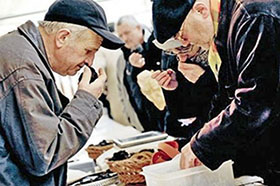
The two working centres are Lalbenque in the Quercy (a Tuesday market, mid-December to mid-March, the largest professional black-truffle market in France) and Sarlat-la-Canéda in the Périgord Noir itself (a Saturday market, slightly smaller, more accessible to tourists). The Saturday market in Carpentras (Vaucluse, Provence) carries the southern French production; the Norcia market in Umbria handles the Italian Périgord. Prices through the season range CHF 1,200–2,500 per kilogramme at the retail layer, with Spanish Aragonese specimens trading slightly below French and Italian despite often equivalent quality — partly historical reputation, partly the gravity of the Périgord brand.
The classical kitchen
The Périgord truffle has built around itself the most elaborate culinary apparatus of any species in the genus. The classical French preparations — sauce Périgueux, en croûte, in a Bresse poularde, melted under brie de Meaux — all rely on warming, not searing; the aromatic compounds of melanosporum open with mild heat and hold their character through several minutes of cooking, where the white Alba\'s profile collapses in seconds.
Three classical preparations are unfailingly worth knowing. Sauce Périgueux: a reduction of Madeira and demi-glace, finished with finely chopped Périgord and butter mounted off the heat. Served over a poached chicken breast or a slice of foie gras; codified by Escoffier in Le Guide Culinaire (1903). Brouillade truffée en croûte de pain: a country loaf hollowed out, filled with truffle scrambled eggs, baked briefly until the crust crisps; a winter village dish from the Quercy. Poularde de Bresse demi-deuil: a whole Bresse chicken, slices of black truffle slid under the skin before poaching in aromatic broth; a Lyonnaise dish, codified by the chef Eugénie Brazier in the 1920s, that survives in serious French restaurants into the present.
On the regional menu of the Périgord itself, the truffle appears in simpler form. A weekend market in Sarlat in February, a handful of fresh Périgord truffles, butter, eggs, a country loaf — the small-format kitchen that the visiting buyer discovers a few hundred metres from the dealer's table.
More on the species\' botany under Black Périgord truffle; on cultivation under Truffle cultivation; and on the Italian counterpart under Alba truffle market.
Frequently asked questions
Where exactly is the Périgord?
Does a "Périgord truffle" actually come from the Périgord?
When is the Périgord truffle in season?
Why did Périgord production collapse in the twentieth century?
How does the modern Périgord market work?
What is "sauce Périgueux"?
Glossary
- Périgord Noir · Périgord Blanc
- The two principal sub-regions of the Périgord. The Black Périgord (around Sarlat) is the truffle heartland; the White Périgord (around Périgueux) is the historical capital and the broader truffle landscape.
- Lalbenque
- The Tuesday winter truffle market in the Quercy. The largest professional Périgord truffle market in France; mid-December to mid-March.
- Sarlat-la-Canéda
- The medieval centre of the Périgord truffle trade. The Saturday winter market remains a working centre and a tourist destination.
- Sauce Périgueux
- The classical French reduction of Madeira, demi-glace, butter and chopped Périgord truffle. Codified by Escoffier in Le Guide Culinaire (1903).
- Phylloxera
- The grape pest that devastated French viticulture in the 1880s and 1890s. The accompanying replanting removed many of the host oak stands and triggered the long Périgord decline.
Sources
- Vittadini, C. (1831). Monographia Tuberacearum. Milan — the founding scientific monograph; melanosporum is described here.
- Escoffier, A. (1903). Le Guide Culinaire. Sauce Périgueux and the codification of French haute cuisine.
- de Lune, P. (1656). Le cuisinier. Paris — early French recipe collection that already records truffle-under-the-skin chicken.
- Hall, I. R., Brown, G. T. and Zambonelli, A. (2007). Taming the Truffle. Timber Press, Portland — chapter on French production decline and renaissance.
- Reyna, S. and Garcia-Barreda, S. (2014). "Black truffle cultivation: a global reality." Forest Systems, 23(2): 317–328 — Spanish and Italian comparator.
- Fédération Française des Trufficulteurs — French federation of truffle producers; market schedule and regional plantation registers.
- Ente Pébeyre, Cahors — registered French dealer; reference for working market dynamics.