The summer truffle (Tuber aestivum) is the most widely distributed culinary truffle in Europe, the most affordable, and the most heat-tolerant. It is also, for many people, the first truffle they cook with — a sensible place to start. The aroma is mild rather than elaborate; the texture is firm and forgiving; the price tolerates experiment. In Italy it is called scorzone ("rough rind"); in France truffe d'été; in German-speaking Europe simply Sommertrüffel. The cooking that surrounds it is correspondingly domestic — a truffle for breakfast eggs, summer risottos and casual pasta, not for the Sunday menu.
A name from Vittadini
The species was described in Carlo Vittadini's 1831 Monographia Tuberacearum, the same monograph that fixed magnatum and melanosporum. The epithet aestivum is Latin for "of summer", a straightforward seasonal name. Vittadini's treatment originally included the autumn form — what later authors would call Tuber uncinatum (the Burgundy) — and the modern molecular case for re-uniting the two forms (Paolocci et al., 2004) is in some ways a return to Vittadini's original view. See Burgundy truffle for the longer discussion.
The summer truffle has the longest documented culinary history of the European genus. Roman sources — Pliny the Elder's Historia Naturalis, Apicius's De Re Coquinaria — describe truffles in terms that match aestivum more closely than the winter species: a summer food, of mild scent, paired with herbs and oil. The medieval Italian lay manuscripts that survive — the Liber de Coquina (Naples, c. 1300) and the Anonimo Toscano (c. 1400) — give summer truffle recipes consistent with modern usage. The species enters formal European cookbooks well before the Périgord boom of the nineteenth century.
Appearance and aroma
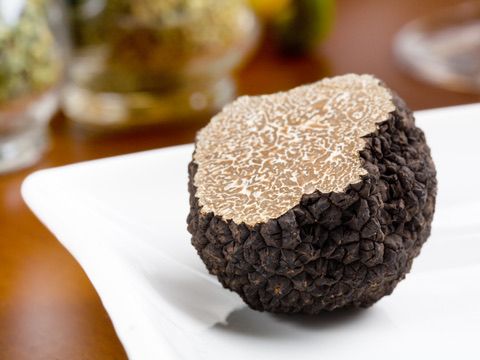
The outer skin (the peridium) ranges from light to dark brown and is studded with large, wart-like protrusions arranged in a polygonal pattern. The flesh (the gleba) is ivory to chocolate brown, lighter than the Burgundy and markedly lighter than the Périgord, with fine white veins forming an open marbling that becomes visible when the truffle is sliced thin. A ripe specimen feels firm and crisp under the thumb; a soft truffle is over-ripe; a hollow cut is a sign of poor handling.
The aroma is mild, nutty, mushroomy — fresh porcini, walnut, damp leaf litter, with an undertone of cellar earth. Compared with Burgundy or Périgord, it is markedly less assertive, and chemical analyses (Splivallo et al., 2007) confirm a smaller and less volatile bouquet. This makes the species no less interesting; it asks for different companions: less butter, more freshness, lemon zest, olive oil, parmesan. Not the material for sauce Périgueux, but ideal for carpaccios, summery risottos, egg dishes and salads.
Where it grows
The summer truffle is the most widely distributed culinary truffle in Europe. It grows from Spain and Portugal through France, Italy, Switzerland, Germany, Austria and Hungary as far as Croatia and parts of Poland. Soil and host requirements are catholic: calcareous soil with a pH around 7.5 to 8, mature oak (Quercus pubescens, Q. ilex, Q. robur), hazel (Corylus avellana), beech (Fagus sylvatica) or hornbeam (Carpinus betulus). Mediterranean to temperate climates suit it; the species copes with heat better than melanosporum and with cold better than magnatum.
In Italy it is called scorzone, the rough rind, and is marketed alongside the autumn Burgundy at the same fairs (Acqualagna, Norcia). In France it is the truffe d'été, handled by the same dealers who deal in melanosporum but at a fraction of the price. In Switzerland and Germany the summer truffle is the species amateur hunters most frequently encounter; the Swiss truffle association runs summer-form training across the western cantons.
- Botanical
- Tuber aestivum
- Season
- May – September
- Region
- Central Europe · Mediterranean
- Market price
- CHF 200 – 600/kg
Season at a glance
- May: first specimens from southern Italy and Spain. Aroma still developing; quality variable.
- June and July: peak season. The widest range of European harvests is on the market; Italian fairs run weekly markets in Acqualagna and Norcia.
- August and September: a gradual transition. The autumn rains shift the harvest from aestivum to uncinatum on the same trees.
- October onward: the species is no longer at its best; the autumn Burgundy takes over.
The market
The summer truffle is the most stable of all culinary truffles in price. Three reasons: the species is widely distributed, the season is long (five months), and the supply base is diversified across many small producers. Prices range roughly CHF 200 to 600 per kilogram through the season, with mild peaks during dry weeks. Smaller pieces and lower grades trade lower; off-season specimens (chiefly from southern Europe in the early spring) are cheaper still.
Where to buy with confidence: registered Swiss and Italian dealers, weekly Italian markets around Acqualagna and Norcia, French dealers in the Provence and Périgord, and a small number of Swiss specialists who source directly from these channels. See Where to buy truffles and Truffle prices for the longer guide. Quality declarations matter less here than with the more expensive species — but a clear harvest date and a botanical label still distinguish a serious dealer from a casual one.
In the kitchen
The summer truffle's kitchen is summery: lighter, fresher, more vegetable. The species pairs naturally with raw and gently warmed dishes — carpaccios, summer risottos, soft eggs, salads, mild cheeses, herb-driven sauces. It tolerates moderate heat (five to ten minutes in a butter sauce or risotto) better than the Alba, but loses character under sear-level heat; finish dishes with a final shave at the table for clarity.
Pairings that work: olive oil, lemon zest, mild dairy, eggs, mild cheeses (mozzarella, fresh pecorino, young Parmigiano), tomato (in the brief peak window of the Italian summer), basil, rocket. Pairings to avoid: vinegar, citrus juice (zest is fine), strong herbs, anchovy. At table, a Pinot Grigio, an Italian Verdicchio, a Swiss Chasselas — anything dry, fresh and secondary to the truffle.
Three summer dishes
Brief sketches, scaled to the home cook. None of these recipes ask for technique you do not already have.
Carpaccio di manzo, scorzone, parmigiano
Raw beef sliced wafer-thin (silverside, fillet, top sirloin), dressed with olive oil and fleur de sel. A grating of young Parmigiano-Reggiano, a generous shave of summer truffle, nothing more. The dish that perhaps best demonstrates the species' summer profile.
Spaghetti aglio, olio, scorzone
A summer riff on the classical Roman pasta. Spaghetti boiled al dente, tossed with olive oil in which a clove of garlic has been gently warmed (and removed before serving), a flake of chilli, a spoon of pasta water, and a generous shave of summer truffle. No cheese; the dish works precisely because it does not. The Italian everyday at its best.
Œufs au plat, beurre noisette, truffe d'été
Fresh eggs fried in clarified butter at low heat until the white sets and the yolk remains liquid. Slide onto a warm plate. Spoon a teaspoon of butter heated to noisette (pale brown, hazelnut-scented) over the top. Shave 5 g of summer truffle. Toast on the side. A French breakfast at its most casual; a working Tuesday in midsummer.
Frequently asked questions
Is the summer truffle a real truffle or a substitute?
How is it different from the Burgundy truffle?
Can I heat the summer truffle?
What does it cost?
How long does a summer truffle keep?
Where can I find one in Europe?
Glossary
- Scorzone
- Italian for "rough rind". The standard Italian name for the summer truffle, used at fairs and on menus across the peninsula.
- Truffe d'été
- The French equivalent. Common in Provençal markets through June and July, often handled by the same dealers who handle the winter Périgord.
- Peridium · Gleba
- The outer skin and the flesh, respectively. In aestivum the peridium is dark brown with polygonal warts; the gleba is light brown to ivory with fine white veining.
- Mycorrhiza
- The symbiosis between fungus and host root. Tuber aestivum is unusually catholic in choice of host — oak, hazel, beech, hornbeam — which explains its wide European distribution.
- Acqualagna · Norcia
- Italian truffle towns in the Marche and Umbria respectively. Both run weekly summer markets through July and August, where summer truffles are graded and sold alongside the first autumn Burgundies.
Sources
- Vittadini, C. (1831). Monographia Tuberacearum. Milan. The species was described in this monograph; the autumn form (later split as Tuber uncinatum) was originally included.
- Paolocci, F. et al. (2004). "Re-evaluation of the Tuber aestivum species complex by molecular markers." FEMS Microbiology Letters, 247(1): 41–47. The molecular case for treating aestivum and uncinatum as one species.
- Splivallo, R. et al. (2007). "Truffle volatile organic compounds: chemistry, ecology and emerging biotechnological applications." New Phytologist, 175: 469–474.
- Hall, I. R., Brown, G. T. and Zambonelli, A. (2007). Taming the Truffle. Timber Press, Portland. Aestivum is treated alongside Burgundy in the chapters on Central European cultivation.
- Apicius, M. G. (1st century AD, attribution disputed). De Re Coquinaria. Latin recipe collection; truffle preparations consistent with modern aestivum usage are recorded.
- Schweizerische Trüffelvereinigung — Swiss truffle association; summer-form training and regional records.