Truffles are subterranean ascomycete fungi. They live in symbiosis (mycorrhiza) with the roots of certain trees — chiefly oak, hazel and lime. Which species thrives at a site depends on soil chemistry, climate and the host trees available. Most species are too bitter, too small or too unaromatic to interest the kitchen; about ten are culinarily significant. Four of these dominate the European market and define the working calendar.
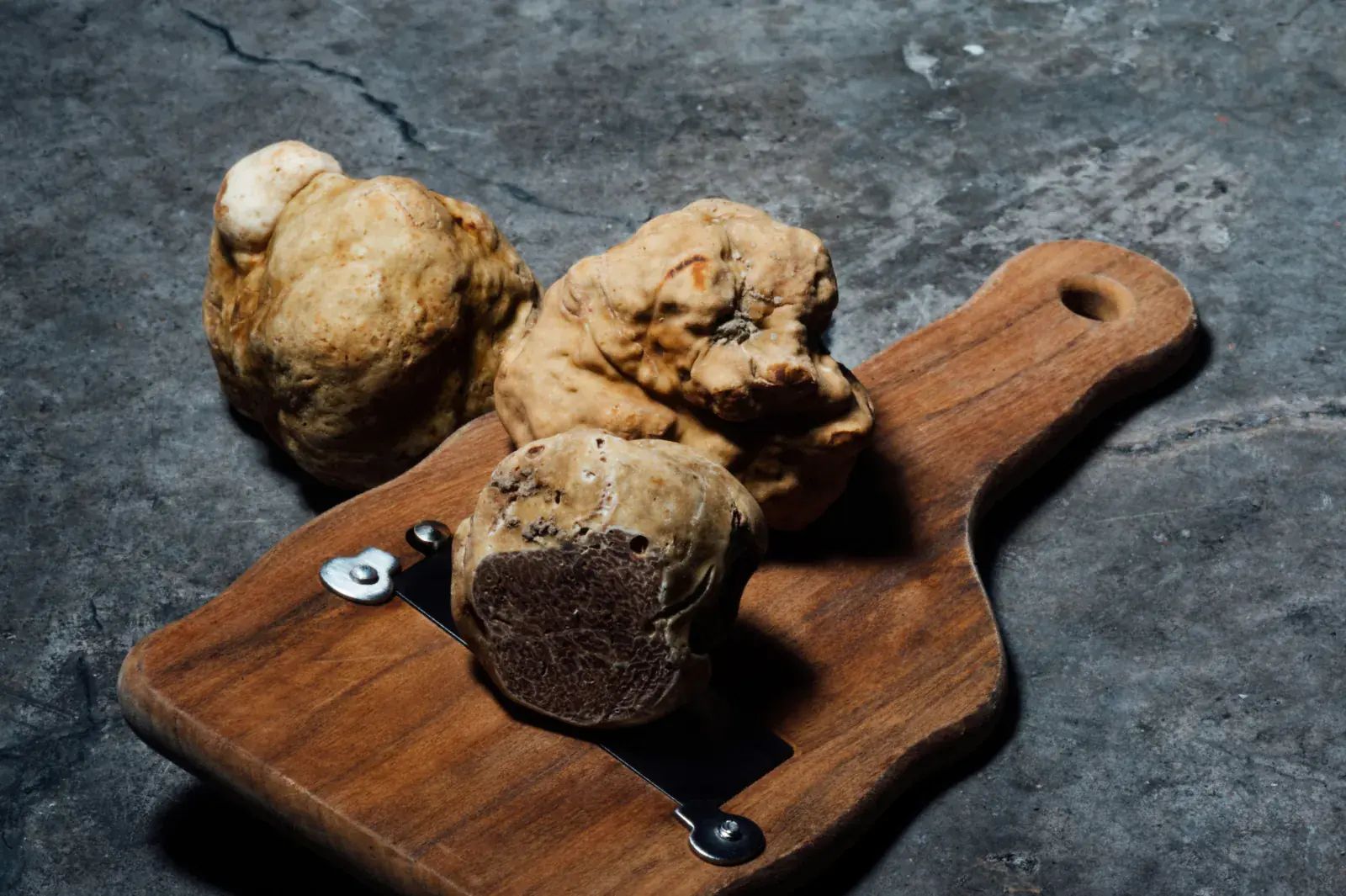
White Alba Truffle
The queen. Wild grown, eaten only raw, October to December.
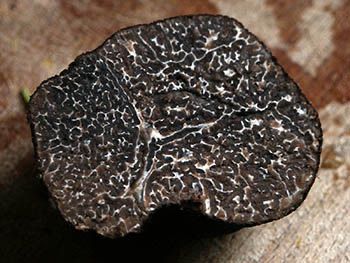
Black Périgord Truffle
The classic of haute cuisine. Aromatic, heat-stable, December to March.
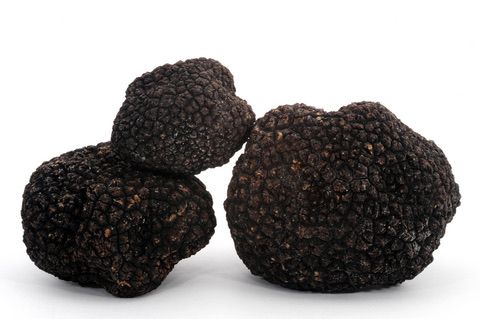
Burgundy Truffle
The Central European speciality. Hazelnut, autumnal, September to January.
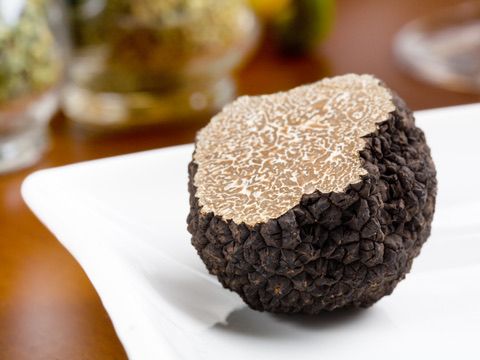
Summer Truffle
The democratic truffle. Mild, widespread, May to September.
The four main families
The white Alba truffle (Tuber magnatum) is the rarest and most expensive — wild only, exclusively raw, October to January, with the Italian autumn fairs as the working market. The black Périgord (Tuber melanosporum) is the heat-stable winter species at the heart of French haute cuisine — aromatic, robust, cultivated, December to March. The Burgundy (Tuber uncinatum) is the most commonly hunted truffle in Switzerland and the secret favourite of many chefs — autumnal, hazelnut-noted, September to January, the only species regularly produced by Swiss hunters. The summer truffle (Tuber aestivum) is the most widely distributed in Europe — mild, accessible, a sensible introduction, May to September.
Ranked by season
The four species cover the full European calendar. Summer truffle (May–September) opens the year; the Burgundy (September–January) takes over for the autumn; the white Alba (October–January) joins for a short and intense overlap; the Périgord (December–March) closes the cycle. The two leanest months are March and April — the Périgord is winding down and the summer truffle has not yet started. See Season & occurrence for the longer calendar with regional notes.
Ranked by price
The 2026 retail spread is roughly:
- White Alba (Tuber magnatum) — CHF 3,000–6,000/kg. The structural premium of a wild-only species in a short window.
- Black Périgord (Tuber melanosporum) — CHF 1,200–2,500/kg. Cultivated, longer season, freezable.
- Burgundy (Tuber uncinatum) — CHF 400–900/kg. Wider distribution, longer harvest.
- Summer (Tuber aestivum) — CHF 200–600/kg. Broadest distribution, longest season, most stable price.
Within each species, daily prices vary 30–50 % across a season with weather and harvest size. See Truffle prices for the working orientation.
How to choose
Choosing between the species means first choosing a season: in summer, Tuber aestivum; in early autumn, Tuber uncinatum; in late autumn, the white Alba; in winter, the black Périgord. Within a season, freshness beats species: a two-day-old summer truffle is better than a week-old Périgord. The kitchen rule that follows: buy small, buy fresh, buy in season. Stockpiling is rarely worth the cost; storage above a week is rarely worth the effort. More on practical handling under Storage; on buying with confidence under Where to buy truffles.
Other species
Beyond the four main culinary families, several minor European species occasionally reach the kitchen. Tuber borchii (the bianchetto or whitish truffle) is a milder relative of the white Alba, fruiting January to April; sometimes mis-sold as magnatum at the cheapest end of the market. Tuber brumale (the muscat truffle) is a winter species sometimes mistaken for melanosporum, with a similar appearance but a coarser aroma and a lower price. Tuber mesentericum (the bitter truffle) is darker still, less aromatic and less culinarily significant. The Chinese Tuber indicum is the most common substitution in the European market, mis-sold as melanosporum at a fraction of the price; insist on the botanical name on the receipt. See Where to buy truffles for the substitution check.