
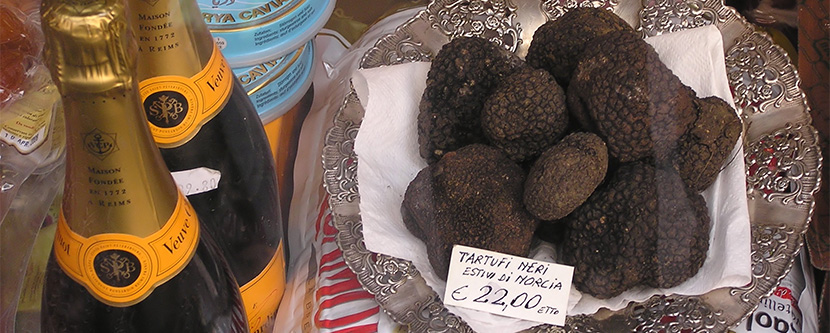
The English word truffle has travelled. Its Latin root predates the Roman Empire; its modern shape was settled in late mediaeval French; its current spelling and meaning fixed in Tudor England. Along the way, the word picked up a chocolate cousin and a small family of regional variants. The article below traces the journey, sets the capitalisation and plural rules, and disposes of the chocolate question.
The Latin root
The word descends, by way of Old French, from the Latin tūber — literally "lump", "swelling" or "tuberous root". Pliny the Elder, in his Naturalis Historia (c. 77 AD), uses the form tubera terrae, "tubers of the earth", to distinguish the underground fungi from above-ground tubers and from the more common edible mushrooms of Roman cooking. An older folk-Latin form, terrae tūber, seems to have shaped the word as it travelled through Romance dialects, where the unstressed second syllable softened and shifted into the forms recognised today.
The Latin tūber survives as the modern botanical genus name. Carlo Vittadini's Monographia Tuberacearum (1831) — the founding scientific monograph on European truffles — kept the Roman term and built the modern taxonomy around it: Tuber magnatum, Tuber melanosporum, Tuber uncinatum, Tuber aestivum. The genus name is always capitalised and italicised in scientific writing; the common English name is not.
The Romance descendants
Italian uses tartufo, French truffe, Spanish and Portuguese trufa, Catalan tòfona, Romanian trufă. All these forms trace back to the same Latin root, but the path was not straight. Folk etymology, regional dialects and the influence of nearby words — particularly tuffer in Old Provençal, a verb meaning "to dig out" — produced a small family of words for a small family of fungi.
Italian preserved the Latin sound shape most faithfully: tartufo is recognisably the descendant of terrae tūber. French smoothed the second syllable, dropping the -er ending and softening the consonant cluster: truffe emerges in Old French around the thirteenth century. Spanish and Portuguese followed the French pattern; Catalan kept a closer link to the Provençal verb form. Each language settled its own spelling by the early modern period.
Into English
English picked up the word from French in the late sixteenth century. The first attested English use is in 1591 (in Sir Hugh Plat's The Jewell House of Art and Nature); by Shakespeare's time the spelling and meaning were settled. The word is treated as a regular English noun: one truffle, two truffles, the truffle, the truffles. The singular is also used collectively in fixed phrases — "truffle season", "truffle hunting", "truffle market" — much as English uses "fish" or "deer" without a plural -s in collective contexts.
The pronunciation in English is /ˈtrʌfəl/ — the first syllable rhymes with "stuff", not "true". The French pronunciation /tʁyf/ retains a closer fit to the Latin original. American and British English pronounce the word identically; regional variation is minimal.
A note on capitalisation
The genus name Tuber is always capitalised and italicised, as is the convention for botanical Latin: Tuber magnatum, Tuber melanosporum, Tuber uncinatum, Tuber aestivum. The species epithet — magnatum, melanosporum, uncinatum, aestivum — is italicised but not capitalised. The common English names — white truffle, Périgord truffle, Burgundy truffle, summer truffle — are not capitalised unless they begin a sentence or contain a proper noun (Périgord, Alba). The same rule applies in French (truffe blanche d'Alba) and Italian (tartufo bianco d'Alba).
- Latin root
- tūber
- Italian
- tartufo
- French
- truffe
- Plural (EN)
- truffles
The chocolate cousin
A "chocolate truffle" is a chocolate confection — a small ball of ganache rolled in cocoa powder, sometimes coated in tempered chocolate. It is named only for its visual resemblance to a knobbly, dust-covered truffle dug from the earth. The two share nothing else.
The confection is a French invention of the late nineteenth century. Auguste Escoffier records it in his 1922 Le Livre des Menus, but the form had already settled in Paris and the larger French provincial cities by the 1880s. The British chocolatier Charbonnel et Walker (Mayfair, founded 1875) is among the earliest documented commercial producers; Belgian and Swiss chocolatiers adopted the form within a decade. The confection is younger than the Périgord truffle market, far younger than the Italian autumn fairs, and much younger than the species itself. The fungus is older than written history; the chocolate is younger than the railway.
The German question
A perennial language question on the German side of the truffle world: is it der Trüffel or die Trüffel? The standard German answer — feminine, die Trüffel, plural die Trüffeln — is not universal: Swiss German, Austrian and southern German speech often uses the masculine, by analogy with other mushroom names (der Steinpilz, der Pfifferling). For the longer discussion, see the German companion article on trueffel-shop.com.
Frequently asked questions
What is the plural of "truffle"?
Why does Italian say "tartufo" but French "truffe"?
Should I capitalise "truffle"?
Is a chocolate truffle a real truffle?
Do other languages name the truffle differently?
Glossary
- tūber
- Latin: lump, swelling, tuberous root. The root of every Romance and English word for the truffle, and the modern botanical genus name.
- terrae tūber
- Folk-Latin "tuber of the earth". The phrase that shaped the Italian, French and Spanish descendants.
- tuffer
- Old Provençal verb meaning "to dig out". Influenced the French smoothing of the Latin original into truffe.
- Tuber (capitalised)
- The botanical genus name, always italicised and capitalised in scientific writing. Distinct from the common English noun.
- Chocolate truffle
- A French confection of ganache rolled in cocoa powder, named for visual resemblance only. Late-nineteenth-century invention.
Sources
- Pliny the Elder (c. 77 AD). Naturalis Historia, Book XIX. Earliest classical reference using tubera terrae.
- Vittadini, C. (1831). Monographia Tuberacearum. Milan. Modern taxonomy of the genus.
- Oxford English Dictionary, entry "truffle, n." First English attestation 1591 (Plat).
- Trésor de la langue française — historical dictionary of French; entry "truffe" traces the Old French smoothing.
- Escoffier, A. (1922). Le Livre des Menus. Records the chocolate truffle as an established Parisian confection.