The hidden diamond of the forest.
They grow invisibly between the roots of old oaks and hazel shrubs, smelling of earth, musk and something that can neither be named nor reproduced. Truffles are not mushrooms like others — they are a geography, a calendar, a craft and, for centuries, a culinary promise that can be redeemed only with patience, good soil and a fine dog.
The species
The genus Tuber contains over 180 described species worldwide — about ten are culinarily relevant. Four of them shape the European market.
Truffles are subterranean ascomycete fungi which live in symbiosis with the roots of certain trees — chiefly oak, hazel and lime. This symbiosis, the mycorrhiza, supplies the tree with water and minerals; in return the fungus receives sugars. The fruiting body we eat is the visible exception of an otherwise hidden existence.

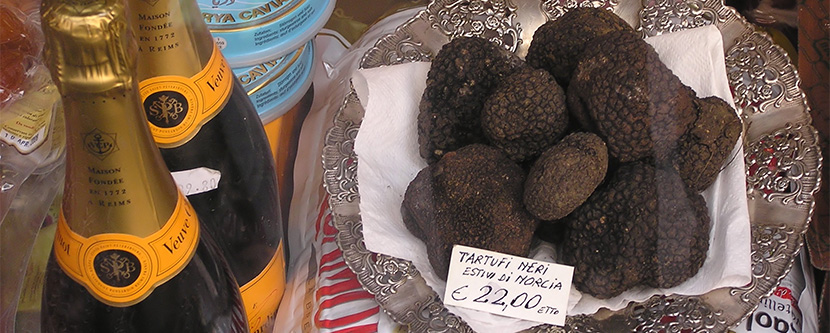
White Alba truffle
The undisputed queen. Cannot be cultivated, found exclusively in the wild, never heated — only raw, shaved razor-thin.
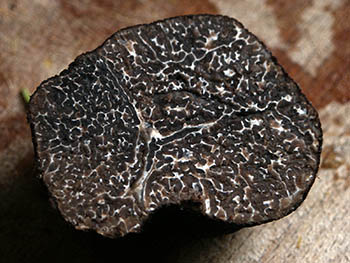
Périgord truffle
The classic of French haute cuisine. Refined hot or cold — from sauce Périgueux to brie de Meaux.
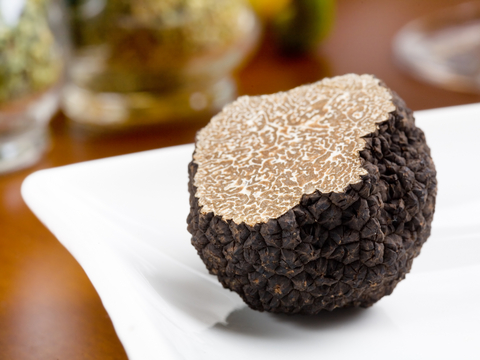
Summer truffle
The democratic truffle. A mild aroma and broad availability — ideal for everyday cooking and a first encounter.
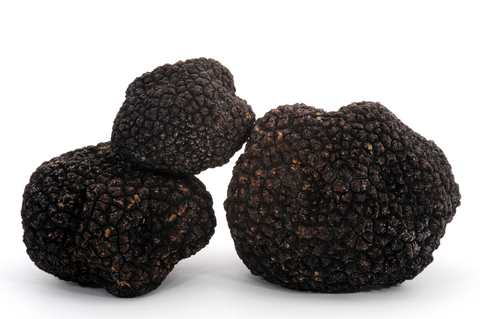
Burgundy truffle
A relative of the summer truffle but later, darker and noticeably more aromatic. A genuine Central European speciality.
What makes a species a delicacy
Not every truffle is a culinary truffle. What matters is aromatic complexity, firmness of the fruiting body and the ability to retain character through storage or heat. The white Alba truffle, for instance, must never be heated — its volatile aromatic profile is measured in seconds. The black Périgord, by contrast, opens up precisely in heat.
Season & occurrence
Truffles are a calendar. To eat them is to eat a region at a particular moment in time — anything else is preserved goods. To the seasonal overview →
Climate, soil, patience
Truffles need calcareous, well-draining soils with a pH between 7.5 and 8.5. They grow within a narrow temperature corridor — too dry and they wither, too wet and they rot. A good truffle plantation produces no earlier than eight years in, and full yields only after fifteen.
- pH range
- 7.5 – 8.5
- Host trees
- Oak · hazel · lime
- First harvest
- after ~8 years
- Full yield
- after 15+ years
A short history
From mythical natural wonder, by way of the royal table, to the quiet renaissance of the twenty-first century — a chronicle in five stations.
A food of the gods
Pliny describes the truffle as a "wonder of nature" — a fruit without root or seed, born of lightning.
Courtly renaissance
The French aristocracy adopts the Périgord truffle as a status symbol at the royal table.
The first cultivation
Joseph Talon plants oaks in the Vaucluse from acorns gathered beneath truffle-bearing trees. The truffle economy begins.
The great collapse
Industrialisation, two world wars and the loss of peasant culture reduce yields to less than 5 % of historical quantities.
A quiet renaissance
Mycorrhizally inoculated plantations, climate adaptation and new markets bring the truffle back within reach — without disenchanting it.
The truffle is the diamond of the kitchen.
Hunting & the truffle dog
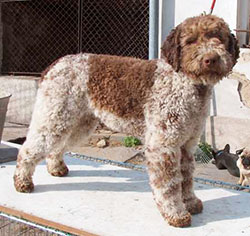
Finding truffles is not luck. It is a partnership of human, dog and forest — practised over years, handed down through generations.
Until well into the twentieth century, pigs were used to hunt truffles in Italy and France. Sows respond instinctively to the truffle's scent, which resembles a sex pheromone — which made them efficient but uncontrollable: the find ended up in the pig's mouth more often than in the farmer's basket. The dog has now displaced the pig completely.
The anatomy of a hunt
An experienced hunt lasts a few hours, begins before sunrise, and follows no plan that a human would understand. The dog ranges widely, suddenly stops, scratches — and the hunter digs with a narrow, curved spade exactly where the dog has paused. Trained dogs work so precisely that the host tree's roots remain undamaged.
Preparation
Three rules suffice for home use: keep dry, store cool, use sparingly.
Cleaning
With a soft brush under a thin trickle of water. Then carefully pat dry at once. Water is the truffle aroma's worst enemy — a minute too long and the fungus begins to surrender its own scent into the water.
Shave, don't slice
With a fine truffle slicer, razor-thin shavings are scattered over the finished dish — never as part of a sauce. The truffle is a seasoning, not an ingredient. Four to six grams per person are entirely sufficient for a main course.
Storage
In the refrigerator, wrapped in a clean kitchen towel, in a sealed glass jar. Change the towel daily. Optionally: bedded in a layer of uncooked rice — which absorbs moisture and takes on the aroma at the same time. More on this in the storage guide.
A short recommendation
The simplest dishes make the best vehicles: a fried egg, tagliatelle in butter, a mild camembert, a potato soup. Anything that overpowers the truffle — garlic, sharp herbs, acidity — does not belong on the same plate.
Glossary & questions
What you have always wanted to know — and what you would never quite dare to ask in a restaurant.